In the rapidly evolving landscape of healthcare, technological advancements are playing a pivotal role in revolutionizing patient care, diagnosis, and treatment. Among these innovations, Generative Artificial Intelligence (Generative AI) has emerged as a groundbreaking tool with immense potential. This article explores the diverse use cases and applications of Generative AI in healthcare, highlighting its transformative impact on the industry.
Understanding Generative AI in Healthcare
Generative AI is a subset of artificial intelligence that focuses on creating new, often realistic, data instances from existing datasets. This technology leverages machine learning algorithms to generate content, ranging from text to images and more. In healthcare, Generative AI holds the promise of improving efficiency, accuracy, and overall patient outcomes.
Diagnostic Precision through Image Generation
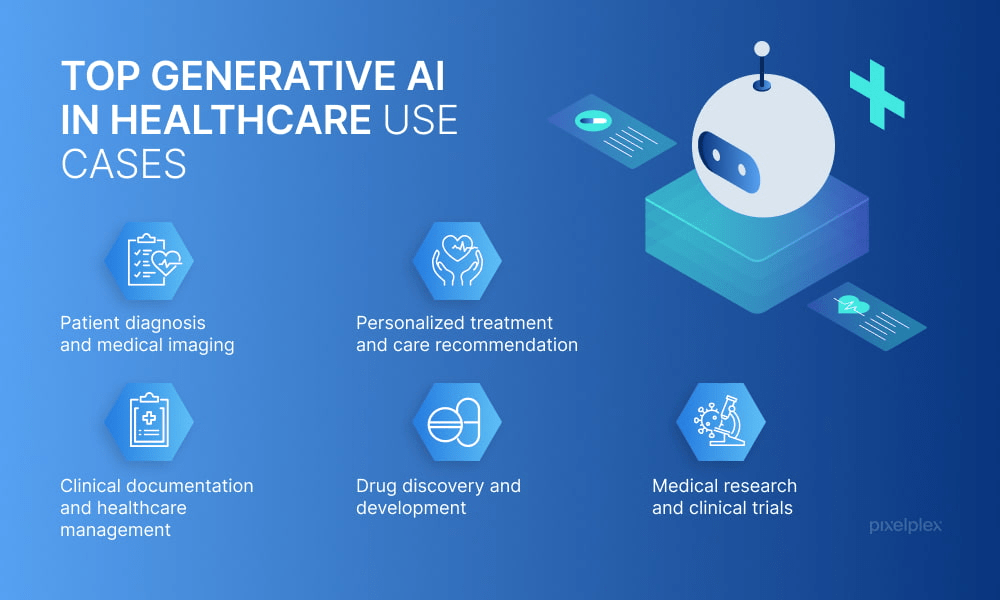
One of the key applications of Generative AI in healthcare is enhancing diagnostic precision through image generation. Medical imaging, such as X-rays, MRIs, and CT scans, is crucial for accurate diagnosis. Generative AI can be employed to generate synthetic medical images, allowing healthcare professionals to train and refine their diagnostic skills without relying solely on scarce real-world data. This not only aids in medical education but also contributes to more accurate and timely diagnoses.
Personalized Treatment Plans with Generative AI
Another significant use case of Generative AI in healthcare lies in the realm of personalized treatment plans. The technology can analyze vast datasets, including patient records, genetic information, and treatment outcomes, to generate personalized and optimized treatment plans. This tailored approach ensures that patients receive treatments that are not only effective but also minimally invasive, reducing the risk of adverse reactions.
Natural Language Processing for Electronic Health Records
Generative AI’s natural language processing capabilities are instrumental in transforming the way healthcare professionals interact with electronic health records (EHRs). The technology can interpret and generate human-like text, making it easier to extract valuable insights from voluminous patient records. This streamlines administrative processes, enhances data accessibility, and enables healthcare providers to make informed decisions based on comprehensive patient histories.
Drug Discovery Acceleration
In the realm of pharmaceuticals, Generative AI is accelerating the drug discovery process. By analyzing massive datasets related to molecular structures, disease pathways, and existing drug interactions, Generative AI can propose novel drug candidates. This significantly reduces the time and resources required for drug development, offering new hope for faster and more effective treatments for various diseases.
Predictive Analytics for Disease Outcomes
Generative AI’s predictive analytics capabilities play a crucial role in forecasting disease outcomes. By analyzing patient data, lifestyle factors, and genetic information, the technology can generate predictive models that assist healthcare professionals in anticipating disease progression and potential complications. This proactive approach enables timely interventions, improving patient care and outcomes.
Ethical Considerations and Challenges
While the applications of Generative AI in healthcare are promising, ethical considerations and challenges must be addressed. Privacy concerns, data security, and the potential for bias in algorithmic decision-making are critical issues that require careful consideration. Striking a balance between innovation and ethical responsibility is essential to ensure the responsible deployment of Generative AI in healthcare.
Conclusion
Generative AI is a transformative force in healthcare, offering a spectrum of applications that enhance diagnostic accuracy, personalize treatment plans, and expedite drug discovery. As the industry continues to embrace this cutting-edge technology, it is essential to navigate the ethical challenges and prioritize patient privacy. The integration of Generative AI into healthcare practices holds the potential to redefine patient care and contribute to the evolution of a more efficient and effective healthcare system.
 Hightech Video
Leave a comment