-
Exploring the Use Cases of Generative AI Solutions for Hospitality
In today’s rapidly evolving hospitality landscape, the integration of advanced technologies has become essential for delivering exceptional guest experiences, optimizing operational efficiency, and staying ahead of the competition. Generative artificial intelligence (AI) solutions have emerged as powerful tools that offer a wide array of applications for hotels, resorts, and other hospitality establishments. From personalizing guest experiences to automating operational workflows, generative AI solutions are transforming the way the hospitality industry operates. In this article, we’ll explore various use cases of gen AI solution for hospitality, highlighting their impact and benefits.

Introduction to Generative AI in Hospitality
Generative AI refers to a class of algorithms and models capable of generating new content based on input data. Unlike traditional AI systems, which operate on predefined rules and patterns, generative AI leverages deep learning techniques to produce outputs that mimic human creativity and intuition. In the hospitality sector, gen AI solution for hospitality utilizes vast amounts of data to create personalized experiences, optimize pricing strategies, automate content generation, and streamline operational processes.
Personalized Guest Experiences
One of the primary use cases of gen AI solution for hospitality is creating personalized guest experiences. By analyzing guest preferences, behaviors, and feedback data, generative AI solutions can generate tailored recommendations for accommodations, dining options, leisure activities, and local attractions. For example, a hotel leveraging generative AI may offer customized room configurations, curated dining menus, and personalized leisure itineraries based on individual guest profiles. This level of personalization enhances guest satisfaction, fosters loyalty, and sets hotels apart in a competitive market landscape.
Dynamic Pricing Optimization
Gen AI solution for hospitality enables hotels to optimize pricing strategies in real-time based on market demand, competitor analysis, and guest segmentation. These solutions leverage predictive analytics and machine learning algorithms to adjust pricing tiers, discounts, and promotions dynamically, maximizing revenue potential while ensuring price competitiveness. By continuously analyzing market trends and guest booking patterns, hotels can optimize pricing decisions to achieve optimal occupancy rates and revenue targets. Dynamic pricing optimization also allows hotels to capitalize on peak demand periods, special events, and seasonal fluctuations, maximizing revenue without sacrificing guest satisfaction.
Content Generation Automation
Content creation is a time-consuming task for hospitality marketers, requiring the production of engaging text, images, and videos across various digital channels. Gen AI solution for hospitality automates content generation by leveraging natural language processing (NLP) and computer vision algorithms to create descriptive narratives, visually appealing imagery, and compelling marketing collateral. Whether it’s crafting social media posts, writing blog articles, or designing promotional materials, AI-powered content generation streamlines marketing workflows and ensures consistency in messaging. By automating content creation, hotels can save time and resources while maintaining a consistent brand identity and engaging with guests across multiple touchpoints.
Virtual Property Tours and Interior Design
Gen AI solution for hospitality enables the creation of immersive virtual tours and realistic renderings of hotel properties, allowing potential guests to explore accommodations and facilities remotely. Moreover, AI-powered design platforms can generate interior design concepts and room layouts tailored to specific aesthetic preferences and spatial constraints. By providing virtual previews of hotel spaces and amenities, these solutions enhance the booking experience and facilitate informed decision-making for both guests and hotel operators. Virtual property tours and interior design simulations also enable hotels to showcase their unique features and offerings, attracting potential guests and differentiating themselves in a crowded marketplace.
Predictive Maintenance and Asset Management
Generative AI algorithms can analyze sensor data from Internet of Things (IoT) devices embedded within hotel infrastructure to predict equipment failures, detect anomalies, and optimize maintenance schedules. By proactively addressing maintenance issues, hotels can minimize downtime, reduce operational costs, and prolong the lifespan of critical assets. Additionally, AI-driven asset management systems facilitate inventory optimization, procurement planning, and resource allocation, ensuring seamless operations and guest satisfaction. Predictive maintenance and asset management solutions enable hotels to optimize resource utilization, improve operational efficiency, and enhance guest experiences by ensuring that facilities and equipment are always in optimal condition.
Multimodal Guest Interfaces
Generative AI solutions offer multimodal guest interfaces that enable seamless interactions across various touchpoints, including voice commands, chatbots, and visual recognition systems. These interfaces leverage natural language understanding (NLU) and computer vision technologies to interpret guest requests, provide relevant information, and facilitate transactions. Whether it’s booking a room, ordering room service, or accessing local recommendations, guests can engage with hotel services using their preferred communication channels, enhancing convenience and accessibility. Multimodal guest interfaces also enable hotels to provide personalized and frictionless experiences, catering to the diverse preferences and needs of modern travelers.
Sentiment Analysis and Feedback Insights
Generative AI solutions incorporate sentiment analysis and feedback insights to gauge guest satisfaction levels, identify areas for improvement, and address potential issues proactively. These solutions leverage machine learning algorithms to analyze guest reviews, social media mentions, and survey responses, extracting valuable insights into guest sentiments and preferences. By monitoring guest feedback in real-time and taking timely action to address concerns, hotels can enhance service quality, reputation, and guest loyalty. Sentiment analysis and feedback insights enable hotels to continuously refine and optimize their offerings, ensuring that guest experiences meet or exceed expectations.
Conclusion
Gen AI solution for hospitality offers a wide range of use cases that can revolutionize various aspects of the hospitality industry, from personalizing guest experiences to automating operational workflows. By leveraging advanced algorithms and machine learning techniques, hotels can create bespoke experiences, optimize revenue streams, and differentiate their offerings in a competitive market landscape. As hotels embrace the power of generative AI, they can unlock new opportunities for growth, efficiency, and guest satisfaction in the evolving hospitality landscape. With the right strategies and technologies in place, hotels can stay ahead of the curve and deliver exceptional experiences that delight guests and drive business success.
-
The Future of AI Solution for Retail: Transforming the Shopping Experience
In the rapidly evolving world of retail, staying ahead of the curve requires embracing innovation and leveraging cutting-edge technologies to meet the ever-changing demands of consumers. Artificial Intelligence (AI) has emerged as a game-changer in the retail industry, offering unprecedented opportunities to enhance customer experiences, optimize operations, and drive growth. As we look to the future, the potential of AI solution for retail is boundless, promising to revolutionize the way we shop and interact with brands. In this article, we explore the future of AI solution for retail, discussing emerging trends, potential applications, and the transformative impact on the retail landscape.

Introduction: The Evolution of AI in Retail
Over the past decade, AI has evolved from a buzzword to a transformative force in the retail industry. From personalized recommendations and virtual assistants to supply chain optimization and predictive analytics, AI-powered solutions are reshaping every aspect of the retail value chain. As we enter a new era of retail innovation, the potential of AI solution for retail to drive growth, improve efficiency, and enhance customer experiences is greater than ever before.
Emerging Trends in AI for Retail
1. Hyper-Personalization
The future of retail lies in hyper-personalization, where every interaction with the customer is tailored to their individual preferences and needs. AI-powered solutions analyze vast amounts of customer data to deliver personalized recommendations, promotions, and experiences, creating a seamless and intuitive shopping journey for each individual shopper.
2. Augmented Reality (AR) and Virtual Reality (VR)
AR and VR technologies are transforming the way consumers interact with products and brands, offering immersive and engaging shopping experiences. AI-powered AR and VR solutions enable customers to visualize products in their own environment, try on clothing and accessories virtually, and even design custom-made products in real-time, blurring the lines between the physical and digital worlds.
3. Conversational Commerce
Conversational commerce, powered by AI-driven chatbots and virtual assistants, is redefining the way customers shop and interact with brands. AI solutions enable natural language processing and machine learning algorithms to understand and respond to customer inquiries, provide personalized product recommendations, and facilitate seamless transactions, all through conversational interfaces such as messaging apps and voice assistants.
4. Predictive Analytics
Predictive analytics is revolutionizing retail operations by enabling retailers to forecast demand, optimize inventory levels, and personalize marketing campaigns with unprecedented accuracy. AI algorithms analyze historical sales data, market trends, and external factors to predict future demand and inform decision-making, helping retailers stay ahead of the curve and meet customer expectations.
Potential Applications of AI Solutions in Retail
1. Personalized Marketing
AI-powered solutions enable retailers to deliver highly targeted and personalized marketing campaigns across various channels, including email, social media, and mobile apps. By analyzing customer data and behavior, AI algorithms can tailor marketing messages and promotions to individual preferences, increasing engagement and driving sales.
2. Enhanced Customer Service
AI-driven chatbots and virtual assistants provide customers with instant assistance and support, answering questions, resolving issues, and guiding them through the shopping journey. By leveraging natural language processing and machine learning, AI solution for retail delivers personalized and efficient customer service, improving satisfaction and loyalty.
3. Supply Chain Optimization
AI solutions optimize supply chain operations by analyzing data from suppliers, distributors, and logistics partners to identify inefficiencies and opportunities for improvement. By optimizing inventory levels, reducing lead times, and improving demand forecasting, AI algorithms streamline supply chain processes, ensuring seamless product availability and delivery for customers.
4. Inventory Management
AI-powered solutions optimize inventory management by analyzing sales data, seasonality trends, and market dynamics to forecast demand and optimize stock levels. By minimizing stockouts and overstocking, AI algorithms improve inventory turnover and reduce carrying costs, ultimately increasing profitability and efficiency.
Case Studies
Amazon
Amazon, the e-commerce giant, is a pioneer in leveraging AI solutions to drive growth and innovation. The company’s recommendation engine analyzes customer data to deliver personalized product suggestions, while its fulfillment centers use AI-powered robotics and automation to optimize operations and improve efficiency.
Alibaba
Alibaba, the Chinese e-commerce giant, uses AI solutions to power its “New Retail” strategy, which integrates online and offline shopping experiences. The company’s AI-driven recommendation engine analyzes customer data to personalize product recommendations, while its brick-and-mortar stores leverage facial recognition and AI-powered checkout systems to enhance convenience and security.
Starbucks
Starbucks, the global coffee chain, uses AI solutions to enhance customer experiences and drive loyalty. The company’s mobile app uses AI-powered personalization to suggest customized drink orders based on customer preferences and purchase history, while its loyalty program uses predictive analytics to offer targeted promotions and rewards.
Challenges and Considerations
While AI solution for retail offers tremendous potential for retailers, they also pose challenges and considerations that need to be addressed:
Data Privacy and Security
AI solutions rely on vast amounts of customer data for training and analysis, raising concerns about data privacy and security. Retailers must ensure compliance with data protection regulations and implement robust security measures to safeguard customer information and prevent data breaches.
Ethical Use of AI
Retailers must use AI solutions responsibly and ethically, taking into account issues such as algorithmic bias, fairness, and transparency. It is essential to mitigate biases and ensure that AI algorithms are used in a way that respects customer rights and values.
Integration with Existing Systems
Integrating AI solutions with existing IT infrastructure and systems can be complex and challenging. Retailers must ensure seamless integration to maximize the value of AI investments and minimize disruption to operations.
Future Outlook
As AI technology continues to evolve, its impact on the retail industry is expected to grow exponentially. Retailers that embrace AI solutions stand to gain a competitive edge by delivering personalized customer experiences, optimizing operations, and driving innovation across the value chain. By leveraging emerging trends and potential applications of AI in retail, retailers can unlock new opportunities for growth, differentiation, and success in an increasingly competitive and dynamic market.
Conclusion
The future of AI solution for retail is promising, with emerging trends such as hyper-personalization, augmented reality, conversational commerce, and predictive analytics reshaping the industry landscape. By embracing AI-powered solutions, retailers can transform their businesses, enhance customer experiences, and drive growth and innovation in an increasingly digital and data-driven world. As we look to the future, AI holds the key to unlocking new opportunities and revolutionizing the way we shop and interact with brands.
-
Implementing a Gen AI Platform for Private Equity: Strategies and Best Practices
Private equity firms operate in a dynamic and competitive landscape, where efficient decision-making and robust risk management are crucial for success. With the emergence of Generative Artificial Intelligence (AI) platforms, firms have an opportunity to leverage advanced technologies to optimize their processes, enhance decision-making, and unlock new opportunities. In this article, we explore the strategies and best practices for implementing a Gen AI platform for private equity, covering key considerations, implementation steps, and success factors.

1. Understanding the Needs and Objectives
Before embarking on the implementation of a Gen AI platform for private equity, it’s essential for private equity firms to clearly define their needs, objectives, and desired outcomes. This involves conducting a comprehensive assessment of existing workflows, processes, and pain points, as well as identifying areas where AI-driven solutions can add value and drive efficiencies.
Key Considerations:
- Identifying Pain Points: Assess current challenges and pain points within the organization, such as manual data entry, inefficient due diligence processes, or suboptimal portfolio management strategies.
- Defining Objectives: Determine specific objectives and goals for implementing a Gen AI platform for private equity, such as improving deal sourcing efficiency, enhancing predictive analytics capabilities, or optimizing portfolio management strategies.
- Aligning with Business Strategy: Ensure that the implementation of a Gen AI platform for private equity aligns with the firm’s overall business strategy and long-term goals, and that it addresses the specific needs and priorities of key stakeholders.
2. Selecting the Right Platform and Vendor
Choosing the right Gen AI platform for private equity and vendor is a critical step in the implementation process. Private equity firms should carefully evaluate potential solutions based on factors such as functionality, scalability, reliability, and vendor reputation. Additionally, firms should consider the platform’s compatibility with existing systems and workflows, as well as its ability to meet regulatory requirements and industry standards.
Evaluation Criteria:
- Functionality: Assess the functionality and capabilities of the Gen AI platform for private equity, including data synthesis, predictive analytics, scenario modeling, and explainable AI.
- Scalability: Evaluate the platform’s scalability and flexibility to accommodate future growth and evolving business needs, such as increasing data volumes or expanding into new markets.
- Reliability: Consider the platform’s reliability and performance, including uptime, data accuracy, and response times, to ensure uninterrupted access to critical data and insights.
- Vendor Reputation: Research the vendor’s reputation and track record in the industry, including customer reviews, case studies, and references, to assess their credibility and reliability.
- Compliance and Security: Verify that the platform complies with relevant regulatory requirements, such as GDPR or CCPA, and adheres to industry best practices for data privacy and security.
3. Data Preparation and Integration
Effective data preparation and integration are essential for the successful implementation of a Gen AI platform for private equity. Private equity firms must ensure that their data is clean, accurate, and accessible, and that it is compatible with the platform’s requirements. This may involve cleaning and standardizing data, integrating disparate data sources, and establishing data governance protocols to maintain data quality and consistency over time.
Data Preparation Steps:
- Data Cleaning: Identify and correct errors, inconsistencies, and missing values in the data to ensure accuracy and reliability.
- Data Standardization: Standardize data formats, units, and conventions to facilitate interoperability and consistency across different datasets and systems.
- Data Integration: Integrate disparate data sources, such as financial databases, market reports, and internal systems, into a centralized data repository for analysis and modeling.
- Data Governance: Establish data governance protocols, including data quality standards, data access controls, and data retention policies, to ensure that data is managed and maintained effectively over time.
4. Model Development and Training
Once the data is prepared and integrated, private equity firms can begin developing and training AI models on the Generative AI platform. This involves selecting appropriate algorithms, configuring model parameters, and training the model using historical data to learn patterns, trends, and relationships.
Model Development Steps:
- Algorithm Selection: Choose the most suitable algorithms and techniques for the specific use case and objectives, such as machine learning, deep learning, or natural language processing.
- Parameter Tuning: Fine-tune model parameters and hyperparameters to optimize performance and accuracy, balancing model complexity with computational resources and training time.
- Training Data Selection: Select relevant and representative training data from historical datasets, ensuring that it captures a wide range of scenarios, outcomes, and trends.
- Model Evaluation: Evaluate the performance of the trained model using validation datasets and performance metrics, such as accuracy, precision, recall, and F1-score, to assess its effectiveness and reliability.
5. Deployment and Integration into Workflows
Once the AI models are trained and validated, private equity firms can deploy them into production environments and integrate them into existing workflows and processes. This may involve developing custom applications, APIs, or integrations to enable seamless interaction between the Generative AI platform and other systems and tools used within the organization.
Deployment Steps:
- Infrastructure Setup: Configure and deploy the Generative AI platform in the organization’s IT infrastructure, ensuring compatibility with existing systems and security protocols.
- Application Development: Develop custom applications or user interfaces to enable stakeholders to interact with the Generative AI platform and access its capabilities, such as data synthesis, predictive analytics, and scenario modeling.
- API Integration: Develop APIs or integrations to enable seamless interaction between the Generative AI platform and other systems and tools used within the organization, such as CRM systems, data warehouses, or portfolio management software.
- User Training and Adoption: Provide training and support to users and stakeholders to ensure they understand how to use the Generative AI platform effectively and incorporate it into their daily workflows and decision-making processes.
6. Monitoring and Continuous Improvement
Implementing a Generative AI platform is not a one-time event but an ongoing process that requires continuous monitoring, evaluation, and improvement. Private equity firms should establish monitoring mechanisms to track the performance and effectiveness of the platform over time, identify areas for improvement, and implement iterative enhancements and updates to optimize its capabilities and outcomes.
Monitoring and Improvement Strategies:
- Performance Metrics: Define key performance indicators (KPIs) and metrics to measure the effectiveness and impact of the Generative AI platform on business outcomes, such as deal sourcing efficiency, portfolio performance, and risk management effectiveness.
- Feedback Mechanisms: Establish feedback mechanisms, such as user surveys, focus groups, or stakeholder interviews, to solicit feedback and insights from users and stakeholders about their experiences with the platform and areas for improvement.
- Iterative Development: Use agile development methodologies to implement iterative enhancements and updates to the Generative AI platform, incorporating feedback and lessons learned from previous iterations to continuously improve its capabilities and outcomes.
- Stay Abreast of Industry Trends: Keep abreast of emerging trends, technologies, and best practices in AI and data science, and incorporate them into the development and evolution of the Generative AI platform to ensure it remains competitive and aligned with the evolving needs of the organization.
7. Ensuring Compliance and Ethical Use of AI
As private equity firms implement Generative AI platforms, it’s essential to ensure compliance with regulatory requirements and ethical standards for the responsible use of AI. Firms must establish robust governance frameworks and protocols to safeguard data privacy, security, and transparency and mitigate potential risks and biases associated with AI-driven decision-making.
Compliance and Ethical Considerations:
- Regulatory Compliance: Ensure that the Generative AI platform complies with relevant regulatory requirements, such as GDPR, CCPA, or HIPAA, and adheres to industry standards and best practices for data privacy, security, and transparency.
- Ethical Use of AI: Establish ethical guidelines and principles for the responsible use of AI, including fairness, transparency, accountability, and human oversight, to mitigate potential risks and biases associated with AI-driven decision-making.
- Data Privacy and Security: Implement robust data privacy and security measures to safeguard sensitive and confidential information, such as encryption, access controls, and audit trails, and ensure that data is handled and processed in compliance with applicable regulations and policies.
- Bias and Fairness: Mitigate potential biases and ensure fairness in AI-driven decision-making by monitoring and auditing AI models for bias, ensuring diverse and representative training data, and incorporating fairness metrics and techniques into model development and evaluation processes.
Conclusion
Implementing a Generative AI platform in the context of private equity presents a unique set of challenges and opportunities. By understanding the needs and objectives, selecting the right platform and vendor, preparing and integrating data, developing and training AI models, deploying and integrating into workflows, monitoring and continuous improvement, and ensuring compliance and ethical use of AI, private equity firms can successfully implement Generative AI platforms to optimize their processes, enhance decision-making, and drive value creation. With the right strategies, best practices, and governance frameworks in place, firms can harness the power of AI to stay ahead of the curve and achieve sustainable growth and success in an increasingly competitive and complex market landscape.
This comprehensive exploration of implementing a Generative AI platform for private equity provides readers with valuable insights into the strategies, best practices, and considerations for successful implementation. Through structured headings, clear explanations, and practical examples, the article offers a roadmap for private equity firms looking to leverage advanced technologies to optimize their processes, enhance decision-making, and drive value creation.
-
Unleashing the Power of Generative AI in Finance: A Comprehensive Overview of Generative AI Platforms
In recent years, the finance industry has been undergoing a transformative evolution driven by technological advancements. One such advancement that has gained significant traction is Generative Artificial Intelligence (AI). Generative AI, a subset of AI, enables machines to generate new content, such as images, texts, and even financial data, mimicking human creativity and intuition. This article aims to delve into the realm of Generative AI, specifically focusing on its application in finance and the emergence of generative AI platforms tailored for financial institutions.
Understanding Generative AI
Generative AI encompasses a set of algorithms and models designed to generate data that is similar to the input data it was trained on. Unlike traditional AI systems that are typically rule-based or rely on large datasets for pattern recognition, generative AI platform for finance has the capability to create new data points by learning the underlying patterns and distributions of the training data.
Key Components of Generative AI:
- Generative Adversarial Networks (GANs): GANs consist of two neural networks, a generator and a discriminator, which are trained simultaneously. The generator generates synthetic data, while the discriminator evaluates the authenticity of the generated data. Through iterative training, GANs learn to produce increasingly realistic output.
- Variational Autoencoders (VAEs): VAEs are generative models that learn the underlying distribution of the input data and generate new data points by sampling from this distribution. Unlike GANs, VAEs work by encoding input data into a latent space and then decoding it back into the original data space.
- Recurrent Neural Networks (RNNs): RNNs are a class of neural networks particularly suited for sequential data. They can generate sequences of data by predicting the next element in a sequence based on the preceding elements.
Generative AI holds immense potential across various domains, including image synthesis, natural language processing, and finance. However, its application in finance comes with its own set of challenges and opportunities.
The Role of Generative AI in Finance
The finance industry deals with vast amounts of data, ranging from stock prices and market trends to customer transactions and risk assessments. Traditionally, financial institutions have relied on statistical models and expert judgment to analyze this data and make informed decisions. However, with the advent of generative AI platform for finance, there has been a paradigm shift in how financial data is generated, analyzed, and utilized.
Applications of Generative AI in Finance:
- Market Simulation and Forecasting: Generative AI models can simulate financial markets and generate synthetic data to forecast market trends and assess potential risks. By training on historical market data, these models can generate realistic scenarios for scenario analysis and stress testing.
- Algorithmic Trading: Generative AI platform for finance can be used to develop algorithmic trading strategies by generating trading signals based on patterns and anomalies in financial data. These strategies can automate trading decisions and optimize trading execution.
- Fraud Detection and Prevention: Financial institutions can leverage generative AI to detect fraudulent activities by generating synthetic data to augment training datasets for fraud detection models. These models can identify unusual patterns and anomalies indicative of fraudulent behavior.
- Portfolio Optimization: Generative AI platforms can assist portfolio managers in optimizing investment portfolios by generating synthetic data for asset allocation analysis and risk management. These platforms can simulate various portfolio scenarios and identify optimal investment strategies.
- Customer Behavior Modeling: By analyzing transactional data and customer interactions, generative AI models can generate synthetic customer profiles and simulate customer behavior. This enables financial institutions to personalize marketing campaigns and enhance customer experience.
- Credit Risk Assessment: Generative AI platform for finance can generate synthetic credit data to assess credit risk and predict loan defaults. By training on historical credit data, these models can simulate credit scenarios and evaluate the creditworthiness of borrowers.
Challenges and Considerations:
While generative AI holds promise in revolutionizing the finance industry, it also presents several challenges and considerations that need to be addressed:
- Data Privacy and Security: Generating synthetic financial data raises concerns about data privacy and security. Financial institutions must ensure compliance with data protection regulations and implement robust security measures to safeguard sensitive information.
- Model Interpretability: The black-box nature of generative AI models can pose challenges in interpreting model outputs and understanding the underlying decision-making process. Financial institutions need to develop techniques for model explainability and transparency.
- Bias and Fairness: Generative AI models are susceptible to biases present in the training data, which can lead to unfair or discriminatory outcomes. It is essential to mitigate biases and ensure fairness in model predictions, particularly in applications such as credit risk assessment and customer profiling.
- Regulatory Compliance: Financial regulators are increasingly scrutinizing the use of AI in finance and imposing regulations to ensure transparency, accountability, and fairness. Financial institutions must navigate regulatory compliance requirements when deploying generative AI solutions.
Generative AI Platforms for Finance
Recognizing the growing demand for generative AI solutions in finance, several technology companies and startups have developed specialized platforms tailored for financial institutions. These platforms offer a range of features and capabilities, allowing financial institutions to harness the power of generative AI effectively.
Key Features of Generative AI Platforms:
- Data Generation and Augmentation: Generative AI platform for finance enables financial institutions to generate synthetic financial data for various applications, including market simulation, fraud detection, and customer behavior modeling. These platforms leverage advanced generative models such as GANs and VAEs to generate realistic data samples.
- Model Training and Deployment: Generative AI platforms provide tools and infrastructure for training and deploying generative models on large-scale financial datasets. They offer scalable computing resources and distributed training capabilities to accelerate model development and deployment.
- Model Interpretability and Explainability: To address the challenge of model interpretability, generative AI platforms incorporate techniques for visualizing and interpreting model outputs. They provide tools for analyzing model behavior and understanding the underlying patterns learned by the model.
- Bias Detection and Mitigation: Generative AI platforms include features for detecting and mitigating biases in generated data and model predictions. They employ fairness metrics and algorithms to identify and address biases related to gender, race, or other sensitive attributes.
- Regulatory Compliance and Governance: Complying with regulatory requirements is paramount for financial institutions deploying generative AI solutions. Generative AI platforms offer features for ensuring regulatory compliance, such as audit trails, model explainability reports, and compliance monitoring tools.
Case Studies:
- AlphaSense: AlphaSense offers a generative AI platform tailored for financial research and analysis. The platform leverages natural language processing (NLP) and deep learning techniques to generate insightful financial reports, market insights, and investment recommendations.
- Nexar Finance: Nexar Finance provides a generative AI platform for algorithmic trading and risk management. The platform uses GANs and reinforcement learning algorithms to generate trading signals and optimize portfolio performance.
- SynthFinance: SynthFinance specializes in synthetic data generation for credit risk assessment and fraud detection. The platform generates synthetic credit profiles and transactional data to augment training datasets for machine learning models.
Future Outlook:
Generative AI platforms are poised to play a crucial role in shaping the future of finance, enabling financial institutions to unlock new opportunities and drive innovation. As generative AI technology continues to advance, we can expect to see further adoption and integration of these platforms across various domains within the finance industry.
Conclusion
Generative AI holds immense promise in revolutionizing the finance industry by enabling financial institutions to generate synthetic data, develop innovative solutions, and make data-driven decisions. While the adoption of generative AI in finance presents challenges such as data privacy, bias, and regulatory compliance, the benefits far outweigh the risks. With the emergence of specialized generative AI platforms tailored for finance, financial institutions have the tools and capabilities to harness the power of generative AI effectively and drive digital transformation in the finance industry.
-
Exploring the Applications of Generative AI Platform for Manufacturing: Unlocking Innovation and Efficiency
In the ever-evolving landscape of manufacturing, the integration of advanced technologies has become imperative for staying competitive and driving innovation. Among these technologies, Generative AI platforms have emerged as a transformative force, offering manufacturers a wide array of applications to enhance efficiency, optimize processes, and enable customization. This article delves into the diverse applications of Generative AI platform for manufacturing, exploring how they are revolutionizing traditional practices and reshaping the industry.
Introduction to Generative AI Platform for Manufacturing
Generative AI platforms represent a subset of artificial intelligence that focuses on generating new content autonomously. In the context of manufacturing, these platforms leverage advanced algorithms, machine learning techniques, and vast datasets to generate designs, optimize processes, and even develop entirely new solutions without explicit human input. By harnessing the power of Generative AI, manufacturers can unlock new possibilities, overcome challenges, and drive innovation across various aspects of the manufacturing lifecycle.
Design Optimization and Innovation
One of the primary applications of Generative AI platform for manufacturing is in design optimization and innovation. These platforms enable manufacturers to explore a wide range of design alternatives, optimize performance criteria, and push the boundaries of creativity in product development.
Automated Design Exploration
Generative AI platforms automate the design exploration process by generating a diverse range of design alternatives based on specified objectives, constraints, and performance criteria. By analyzing historical data, market trends, and user preferences, these platforms can generate innovative designs that optimize various factors such as cost, performance, and manufacturability. This automated design exploration accelerates the design iteration cycle, unlocks novel design possibilities, and ensures designs are optimized for efficiency and effectiveness.
Iterative Design Optimization
Generative AI platforms facilitate iterative design optimization by simulating numerous design iterations and evaluating their performance against specified criteria. By leveraging advanced algorithms for simulation, optimization, and machine learning, these platforms can iteratively refine and improve designs based on feedback from simulations and real-world testing. This iterative optimization process enables manufacturers to identify optimal solutions that meet or exceed design requirements, leading to improved product performance, reliability, and customer satisfaction.
Design for Additive Manufacturing
Generative AI platforms are particularly well-suited for designing components and products optimized for additive manufacturing processes such as 3D printing. By analyzing geometric constraints, material properties, and manufacturing tolerances, these platforms can generate designs that maximize the advantages of additive manufacturing, such as geometric complexity, lightweighting, and part consolidation. This design optimization enables manufacturers to produce innovative products with reduced material waste, improved structural integrity, and enhanced functionality using additive manufacturing technologies.
Production Process Optimization
In addition to design optimization, Generative AI platforms play a crucial role in optimizing production processes, enhancing efficiency, and minimizing waste across the manufacturing value chain.
Production Workflow Optimization
Generative AI platforms optimize production workflows by analyzing production data, resource constraints, and operational parameters to identify inefficiencies and bottlenecks. By simulating various production scenarios and evaluating their impact on key performance indicators such as cycle time, throughput, and resource utilization, these platforms can recommend workflow optimizations that improve productivity and reduce costs. This optimization leads to streamlined operations, reduced lead times, and enhanced overall efficiency in manufacturing processes.
Resource Allocation Optimization
Generative AI platforms optimize resource allocation by balancing production capacity, labor availability, and material usage to maximize efficiency and minimize waste. By analyzing production schedules, inventory levels, and demand forecasts, these platforms can recommend optimal resource allocations that align with production requirements and customer demand. This optimization enables manufacturers to minimize inventory holding costs, reduce stockouts, and optimize production schedules to meet customer needs more effectively.
Energy and Material Efficiency
Generative AI platforms promote energy and material efficiency by optimizing process parameters, material usage, and resource consumption to minimize waste and environmental impact. By analyzing energy consumption data, material usage patterns, and production yields, these platforms can identify opportunities for improvement and recommend strategies to reduce energy consumption, minimize material waste, and optimize resource utilization. This optimization aligns with sustainability goals, reduces operational costs, and enhances the overall environmental sustainability of manufacturing operations.
Quality Control and Assurance
Generative AI platforms enhance quality control and assurance by leveraging AI-powered analytics and automation technologies to detect defects, prevent quality issues, and ensure product reliability.
Predictive Quality Analytics
Generative AI platforms enable predictive quality analytics that anticipate potential defects and quality issues before they occur. By analyzing production data, sensor readings, and historical performance metrics, these platforms can identify patterns and anomalies that may indicate impending quality issues and trigger proactive interventions to prevent defects from occurring. This predictive approach to quality control minimizes scrap and rework, reduces warranty claims, and enhances product reliability and performance.
Real-Time Monitoring and Alerting
Generative AI platforms provide real-time monitoring and alerting capabilities that enable manufacturers to detect quality deviations and anomalies in real-time. By integrating AI algorithms with sensors, cameras, and IoT devices, manufacturers can monitor production processes continuously and identify deviations from expected norms that may indicate quality issues. This real-time monitoring enables manufacturers to take immediate corrective actions, minimize production disruptions, and ensure that only high-quality products reach the market.
Autonomous Quality Inspection
In the future, Generative AI platforms will enable autonomous quality inspection systems that can perform automated inspection and testing of products with minimal human intervention. By leveraging AI algorithms for image recognition, pattern recognition, and defect detection, manufacturers can develop autonomous inspection systems that can identify defects, anomalies, and deviations from quality standards with high accuracy and reliability. This automation of quality inspection processes will improve efficiency, reduce labor costs, and enhance product quality and consistency.
Customization and Personalization
Generative AI platforms enable manufacturers to offer customized and personalized products tailored to individual customer preferences and requirements.
Mass Customization
Generative AI platforms facilitate mass customization by generating customized designs and products that are tailored to individual customer requirements and preferences. By analyzing customer data, market trends, and production capabilities, these platforms can generate personalized designs that incorporate specific features, colors, and configurations requested by customers. This mass customization capability enables manufacturers to offer a wide range of product variants and options without incurring significant additional costs or lead times.
Design for Manufacturability
Generative AI platform for manufacturing support design for manufacturability by generating designs that are optimized for production processes and manufacturing constraints. By considering factors such as material properties, manufacturing tolerances, and assembly requirements, these platforms can generate designs that are easy to manufacture, assemble, and maintain. This design optimization ensures that customized products can be produced efficiently and cost-effectively without sacrificing quality or performance.
Rapid Prototyping and Iteration
Generative AI platform for manufacturing enable rapid prototyping and iteration by automating the design iteration process and accelerating the development cycle. By generating and evaluating numerous design alternatives in a fraction of the time it would take with manual methods, these platforms can quickly iterate on designs, incorporate feedback from stakeholders, and refine prototypes to meet evolving requirements. This rapid prototyping and iteration enable manufacturers to bring customized products to market more quickly, respond to changing customer preferences, and stay ahead of competitors in a fast-paced and dynamic market environment.
Conclusion: Embracing the Potential of Generative AI Platforms
Generative AI platform for manufacturing offer manufacturers a myriad of applications to enhance efficiency, optimize processes, and enable customization in manufacturing. From design optimization and production process optimization to quality control and customization, Generative AI platforms unlock new possibilities and drive innovation across the manufacturing value chain. By embracing the potential of Generative AI platforms and leveraging their transformative capabilities, manufacturers can stay competitive in an increasingly dynamic and complex market landscape, positioning themselves for success in the digital age.
-
Pioneering the Future: Generative AI Platforms for Enterprises
In the fast-evolving landscape of technology and business, the emergence of Generative AI has sparked a revolution in creativity, innovation, and content generation. As organizations increasingly recognize the potential of Generative AI to drive value and competitive advantage, the future of Generative AI platforms for enterprises holds immense promise and potential. In this article, we explore the trajectory of Generative AI platforms, envisioning their future impact on businesses, industries, and society as a whole.
Unveiling the Evolution of Generative AI Platforms
Before delving into the future, it’s crucial to understand the journey that Generative AI platform for enterprises have undertaken thus far. Over the past decade, Generative AI has made significant strides in areas such as image generation, text synthesis, and creative design. From the early days of basic generative models to the advent of sophisticated algorithms like Generative Adversarial Networks (GANs) and Variational Autoencoders (VAEs), Generative AI platforms have evolved to offer unprecedented capabilities and possibilities.
Key Milestones in the Evolution of Generative AI Platforms:
- Introduction of GANs: The development of GANs by Ian Goodfellow and his colleagues in 2014 marked a major breakthrough in Generative AI, enabling the generation of realistic images and videos with unprecedented fidelity and quality.
- Advancements in Natural Language Processing: With the rise of transformer-based models like OpenAI’s GPT series and Google’s BERT, Generative AI platforms have expanded their capabilities to include tasks such as text generation, summarization, and translation.
- Integration of Generative Design: Generative AI platforms have increasingly been applied to creative design tasks, such as product design, architectural design, and artistic creation, enabling designers to explore and optimize design alternatives at scale.
Envisioning the Future of Generative AI Platforms
As we peer into the future, the trajectory of Generative AI platform for enterprises unfolds along several key dimensions, each shaping the landscape of business, technology, and society in profound ways.
1. Enhanced Creativity and Innovation
The future of Generative AI platforms holds the promise of unleashing unprecedented levels of creativity and innovation across industries. As Generative AI algorithms become more sophisticated and capable, businesses will harness these platforms to explore new design possibilities, generate novel content, and pioneer innovative solutions to complex problems. From generating personalized product designs to co-creating with AI-powered assistants, the convergence of human creativity and machine intelligence will drive a renaissance of innovation in the digital age.
2. Augmented Collaboration and Co-Creation
Generative AI platforms will foster a new era of collaboration and co-creation, blurring the boundaries between human and machine creativity. As AI-powered assistants and creative tools become integral parts of the creative process, teams will collaborate seamlessly across geographical boundaries, disciplines, and domains. From designers and engineers to artists and marketers, diverse stakeholders will come together to leverage Generative AI platforms for ideation, iteration, and innovation, driving collective creativity to new heights.
3. Personalized Experiences and Customization
The future of Generative AI platform for enterprises will be characterized by personalized experiences and customization, as businesses leverage AI to tailor products, services, and content to individual preferences and needs. From personalized product recommendations to dynamically generated marketing campaigns, Generative AI platforms will enable organizations to deliver hyper-personalized experiences that resonate with customers on a deeper level. By harnessing the power of data and AI, businesses will move beyond one-size-fits-all approaches to engage audiences with customized offerings that reflect their unique tastes and preferences.
4. Ethical Considerations and Responsible AI
As Generative AI platform for enterprises proliferate and become more ubiquitous, ethical considerations and responsible AI practices will become increasingly important. From ensuring fairness and transparency in AI-driven decision-making to mitigating risks such as bias and misinformation, businesses will need to prioritize ethical principles and adopt robust governance frameworks to guide the responsible use of Generative AI platforms. By embracing ethical considerations and promoting transparency and accountability, organizations can build trust with customers, stakeholders, and society at large, fostering a culture of responsible AI adoption and innovation.
5. Domain-Specific Applications and Vertical Integration
The future of Generative AI platforms will see the proliferation of domain-specific applications and vertical integration, as businesses tailor AI solutions to meet the unique needs and challenges of specific industries and sectors. From healthcare and finance to manufacturing and entertainment, Generative AI platforms will be customized and optimized for specialized use cases, driving innovation and transformation across diverse domains. By integrating Generative AI capabilities into existing workflows and systems, organizations will unlock new efficiencies, insights, and opportunities for growth, shaping the future of work and industry in the digital era.
Driving Forces Shaping the Future of Generative AI Platforms
Several key driving forces will shape the future trajectory of Generative AI platforms for enterprises, each contributing to the evolution and adoption of these transformative technologies.
1. Advancements in AI Research and Technology
Continued advancements in AI research and technology will drive innovation and progress in Generative AI platforms, enabling breakthroughs in areas such as image generation, text synthesis, and creative design. From novel algorithms and architectures to improved training techniques and data management tools, the pace of innovation in AI will fuel the evolution of Generative AI platforms, unlocking new possibilities and capabilities for businesses.
2. Growing Demand for Personalization and Customization
The growing demand for personalized experiences and customization will drive the adoption of Generative AI platforms across industries, as businesses seek to engage and delight customers with tailored offerings and content. From retail and e-commerce to media and entertainment, organizations will leverage Generative AI platforms to create immersive, personalized experiences that resonate with audiences and drive loyalty and engagement.
3. Rapid Digitization and Industry Transformation
The rapid digitization of industries and sectors will accelerate the adoption of Generative AI platforms, as businesses look to harness the power of AI to drive efficiency, agility, and innovation. From digital marketing and advertising to manufacturing and healthcare, organizations will leverage Generative AI platforms to optimize workflows, automate tasks, and unlock new opportunities for growth and differentiation in the digital age.
4. Shift Towards Collaborative and Inclusive Innovation
The shift towards collaborative and inclusive innovation will drive the adoption of Generative AI platforms as organizations embrace co-creation and collective creativity. From cross-disciplinary teams and distributed collaboration to open innovation ecosystems, businesses will leverage Generative AI platforms to foster collaboration and creativity, driving breakthroughs and discoveries that transcend traditional boundaries and silos.
Overcoming Challenges and Seizing Opportunities
While the future of Generative AI platforms for enterprises holds immense promise, it also presents challenges and complexities that organizations must navigate effectively to realize the full potential of these transformative technologies.
Challenges:
- Ethical Considerations: Addressing ethical concerns such as bias, fairness, and privacy in Generative AI platforms requires careful attention and proactive measures to ensure responsible AI adoption and usage.
- Data Quality and Diversity: Ensuring the availability of high-quality and diverse training data is essential for training accurate and reliable Generative AI models, posing challenges related to data collection, curation, and management.
- Interpretability and Explainability: Enhancing the interpretability and explainability of Generative AI models is critical for building trust and understanding among stakeholders, posing challenges related to model transparency and interpretability.
Opportunities:
- Innovation and Differentiation: Generative AI platforms offer organizations unprecedented opportunities for innovation and differentiation, enabling them to create unique and compelling experiences, products, and content that set them apart from competitors.
- Personalization and Customization: Leveraging Generative AI platforms, businesses can deliver personalized and customized experiences that resonate with customers on a deeper level, driving loyalty, engagement, and lifetime value.
- Collaboration and Co-Creation: By fostering collaboration and co-creation, Generative AI platforms empower organizations to tap into the collective creativity and expertise of diverse stakeholders, driving breakthroughs and discoveries that drive business success and societal impact.
Conclusion: Charting the Course for the Future
As we chart the course for the future of Generative AI platforms for enterprises, it’s clear that these transformative technologies hold immense promise and potential to reshape industries, drive innovation, and unlock new opportunities for growth and prosperity. By embracing the evolution of Generative AI platforms and harnessing their capabilities, organizations can pioneer the future of creativity, innovation, and value creation in the digital age, shaping a world where human and machine creativity converge to drive positive change and progress. As we embark on this journey, let us seize the opportunities, overcome the challenges, and pioneer a future where Generative AI platforms empower us to imagine, create, and innovate beyond imagination.
-
Unleashing the Power of Generative AI in Healthcare: Applications and Use Cases
In the rapidly evolving landscape of healthcare, technological advancements are playing a pivotal role in revolutionizing patient care, diagnosis, and treatment. Among these innovations, Generative Artificial Intelligence (Generative AI) has emerged as a groundbreaking tool with immense potential. This article explores the diverse use cases and applications of Generative AI in healthcare, highlighting its transformative impact on the industry.
Understanding Generative AI in Healthcare
Generative AI is a subset of artificial intelligence that focuses on creating new, often realistic, data instances from existing datasets. This technology leverages machine learning algorithms to generate content, ranging from text to images and more. In healthcare, Generative AI holds the promise of improving efficiency, accuracy, and overall patient outcomes.
Diagnostic Precision through Image Generation
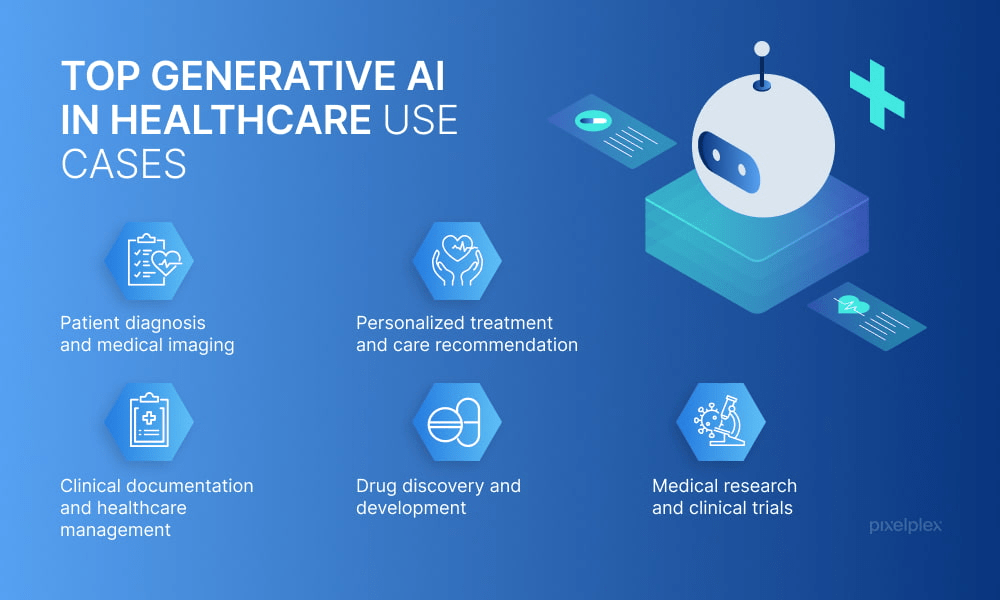
One of the key applications of Generative AI in healthcare is enhancing diagnostic precision through image generation. Medical imaging, such as X-rays, MRIs, and CT scans, is crucial for accurate diagnosis. Generative AI can be employed to generate synthetic medical images, allowing healthcare professionals to train and refine their diagnostic skills without relying solely on scarce real-world data. This not only aids in medical education but also contributes to more accurate and timely diagnoses.
Personalized Treatment Plans with Generative AI
Another significant use case of Generative AI in healthcare lies in the realm of personalized treatment plans. The technology can analyze vast datasets, including patient records, genetic information, and treatment outcomes, to generate personalized and optimized treatment plans. This tailored approach ensures that patients receive treatments that are not only effective but also minimally invasive, reducing the risk of adverse reactions.
Natural Language Processing for Electronic Health Records
Generative AI’s natural language processing capabilities are instrumental in transforming the way healthcare professionals interact with electronic health records (EHRs). The technology can interpret and generate human-like text, making it easier to extract valuable insights from voluminous patient records. This streamlines administrative processes, enhances data accessibility, and enables healthcare providers to make informed decisions based on comprehensive patient histories.
Drug Discovery Acceleration
In the realm of pharmaceuticals, Generative AI is accelerating the drug discovery process. By analyzing massive datasets related to molecular structures, disease pathways, and existing drug interactions, Generative AI can propose novel drug candidates. This significantly reduces the time and resources required for drug development, offering new hope for faster and more effective treatments for various diseases.
Predictive Analytics for Disease Outcomes
Generative AI’s predictive analytics capabilities play a crucial role in forecasting disease outcomes. By analyzing patient data, lifestyle factors, and genetic information, the technology can generate predictive models that assist healthcare professionals in anticipating disease progression and potential complications. This proactive approach enables timely interventions, improving patient care and outcomes.
Ethical Considerations and Challenges
While the applications of Generative AI in healthcare are promising, ethical considerations and challenges must be addressed. Privacy concerns, data security, and the potential for bias in algorithmic decision-making are critical issues that require careful consideration. Striking a balance between innovation and ethical responsibility is essential to ensure the responsible deployment of Generative AI in healthcare.
Conclusion
Generative AI is a transformative force in healthcare, offering a spectrum of applications that enhance diagnostic accuracy, personalize treatment plans, and expedite drug discovery. As the industry continues to embrace this cutting-edge technology, it is essential to navigate the ethical challenges and prioritize patient privacy. The integration of Generative AI into healthcare practices holds the potential to redefine patient care and contribute to the evolution of a more efficient and effective healthcare system.
-
Unlocking the Future: Generative AI in E-Commerce
In the fast-paced world of e-commerce, staying ahead of the competition is imperative. As technology continues to evolve, one groundbreaking innovation that is reshaping the landscape is Generative AI. This cutting-edge technology is not only revolutionizing various industries but is also finding remarkable applications in the realm of e-commerce. In this article, we will explore the diverse use cases of Generative AI in e-commerce and how it is transforming the way businesses operate.

1. Personalized Shopping Experience
Generative AI plays a pivotal role in enhancing the personalized shopping experience for online customers. By analyzing user behavior, preferences, and purchase history, AI algorithms can generate tailored recommendations, leading to higher customer satisfaction and increased sales. The ability to understand individual preferences enables e-commerce platforms to create a unique and engaging shopping journey for each user.
2. Virtual Try-Ons
One of the significant challenges of online shopping is the inability to try on products before making a purchase. Generative AI addresses this issue by providing virtual try-on experiences. Using advanced image recognition and simulation, customers can visualize how clothing, accessories, or even furniture will look on them or in their living spaces. This not only reduces the likelihood of returns but also enhances customer confidence in their buying decisions.
3. Dynamic Content Creation
Generative AI is a powerful tool for content creation in e-commerce. It can automatically generate product descriptions, create engaging social media posts, and even design eye-catching visuals for marketing campaigns. This not only saves time and resources but also ensures consistency in branding and messaging across different platforms. E-commerce businesses can leverage Generative AI to create a strong and cohesive online presence.
4. Fraud Detection and Security
Ensuring the security of online transactions is paramount in e-commerce. Generative AI can be employed to enhance fraud detection mechanisms by analyzing patterns and anomalies in user behavior. By constantly learning from data, these AI systems can identify and prevent fraudulent activities, safeguarding both businesses and customers from potential threats.
5. Inventory Management and Demand Forecasting
Efficient inventory management is crucial for e-commerce success. Generative AI can analyze historical sales data, market trends, and external factors to predict future demand accurately. This enables businesses to optimize their inventory levels, reduce stockouts, and minimize overstock situations. The result is a streamlined supply chain and improved overall operational efficiency.
6. Conversational AI for Customer Support
Generative AI-powered chatbots and virtual assistants are transforming customer support in e-commerce. These intelligent systems can understand and respond to customer inquiries, provide product information, and even assist in the purchase process. By offering instant and efficient support, businesses can enhance customer satisfaction and build trust with their online audience.
In conclusion, the applications of Generative AI in e-commerce are vast and transformative. From creating personalized experiences to optimizing operations, this technology is reshaping the way online businesses operate and connect with their customers. As the e-commerce landscape continues to evolve, integrating Generative AI will become increasingly essential for those aiming to thrive in the competitive digital marketplace. Embracing these advancements will not only drive innovation but also ensure a future-ready and customer-centric approach in the ever-evolving world of e-commerce.
-
Revolutionizing Industries: Applications of Generative AI Automation
In the ever-evolving landscape of technology, Generative AI for automation has emerged as a transformative force across various industries. This cutting-edge technology harnesses the power of artificial intelligence to create, design, and automate tasks, revolutionizing traditional processes. In this article, we will explore the applications and use cases of Generative AI in automation that are reshaping industries.
Understanding Generative AI for Automation
Generative AI refers to a class of artificial intelligence algorithms that generate new content, whether it be images, text, or even entire processes. When applied to automation, it brings a new level of efficiency and creativity to tasks that were once time-consuming and repetitive.
Generative AI in Automation: Use Cases
1. Content Generation and Copywriting
Generative AI excels in creating engaging and persuasive content. For marketers, it can automate the generation of product descriptions, advertisements, and social media posts. This not only saves time but also ensures a consistent and coherent brand voice across various platforms.
2. Design and Creativity
Designing graphics, logos, and user interfaces can be a time-intensive process. Generative AI automates this by generating designs based on specified criteria. It allows designers to focus on refining and customizing designs rather than starting from scratch, boosting productivity and creativity simultaneously.
3. Code Generation and Software Development
Generative AI is increasingly being used in software development to automate the coding process. By understanding the requirements and specifications, it can generate code snippets or even entire programs, accelerating the development cycle. This is particularly useful in meeting tight deadlines and reducing the likelihood of errors.
4. Chatbots and Customer Service
Generative AI is transforming customer service with intelligent chatbots. These bots can understand natural language, answer queries, and even engage in more complex conversations. This not only enhances the customer experience but also reduces the workload on human customer support agents.
5. Financial Analysis and Decision-Making
In the finance industry, Generative AI is employed to analyze vast datasets and generate insights for better decision-making. It can automate tasks such as risk assessment, fraud detection, and portfolio optimization, allowing financial institutions to make more informed and efficient choices.
Challenges and Considerations
While Generative AI for automation offers tremendous benefits, it is not without its challenges. Ensuring ethical use, addressing biases in generated content, and maintaining data privacy are critical considerations. Moreover, the technology is continually evolving, and organizations must stay updated to harness its full potential.
Conclusion
Generative AI for automation is a game-changer across diverse industries. From content creation to software development, its applications are reshaping how businesses operate. Embracing this technology allows organizations to streamline processes, boost creativity, and stay competitive in an increasingly automated world. As we move forward, the integration of Generative AI will likely become a standard practice, marking a new era of efficiency and innovation.
-
Unlocking the Power of Blockchain Consulting Companies Can Help Your Business
Blockchain technology is becoming increasingly popular across industries due to its ability to provide secure, transparent, and decentralized data management. However, the implementation and development of blockchain solutions can be a daunting task for businesses without prior experience in the field. This is where a blockchain consulting company can prove to be invaluable.
A blockchain development company is a team of experts who specialize in creating and implementing blockchain solutions for businesses. These companies provide consulting services to help businesses understand the benefits of blockchain technology and how it can be used to solve business challenges. Here are some of the key benefits of using a blockchain consulting company for your business:
- Expertise in blockchain technology
A blockchain consulting company is staffed with experts who have a deep understanding of blockchain technology. These experts have the knowledge and experience necessary to design and implement blockchain solutions that are tailored to the specific needs of your business. They can guide you through the entire process, from the initial planning stages to the final deployment of your blockchain solution.
- Customized blockchain solutions
Every business is unique, and a one-size-fits-all blockchain solution is not always the best approach. A blockchain consulting company can work with your business to design and implement a customized blockchain solution that meets your specific needs. This includes determining which blockchain platform is best suited for your business and identifying the most appropriate use cases for blockchain technology.
- Reduced risk
Implementing a new technology like blockchain can be risky, especially for businesses that do not have experience with it. A blockchain consulting company can help to reduce this risk by providing expert guidance and support throughout the entire process. This includes assessing the feasibility of your blockchain solution, identifying potential risks and challenges, and developing strategies to mitigate those risks.
- Time and cost savings
Implementing blockchain technology can be a time-consuming and costly process. A blockchain consulting company can help to streamline the process and reduce costs by providing expert guidance and support. They can help you to identify the most cost-effective solutions and ensure that the implementation process is as efficient as possible.
- Improved security
One of the key benefits of blockchain technology is its ability to provide secure and transparent data management. A blockchain consulting company can help to ensure that your blockchain solution is designed with security in mind. This includes implementing robust security measures, such as encryption and multi-factor authentication, to protect your data from unauthorized access.
- Improved efficiency and transparency
Implementing a blockchain solution can improve the efficiency and transparency of your business processes. A blockchain consulting company can help you to identify areas where blockchain technology can be used to streamline processes and improve transparency. For example, blockchain technology can be used to track the supply chain of a product, providing complete transparency and traceability from the source to the end consumer.
- Regulatory compliance
Implementing a blockchain solution can involve navigating complex regulatory frameworks. A blockchain consulting company can help you to navigate these regulations and ensure that your blockchain solution is compliant with relevant laws and regulations. This can help to minimize the risk of legal challenges and penalties.
In conclusion, blockchain technology has the potential to revolutionize the way that businesses operate. However, implementing blockchain solutions can be a complex and daunting task. A blockchain consulting company can help to mitigate the risks associated with implementing blockchain technology by providing expert guidance and support. This includes designing and implementing customized blockchain solutions, reducing risk, saving time and costs, improving security, efficiency, and transparency, and ensuring regulatory compliance. By partnering with a blockchain consulting company, businesses can unlock the full potential of blockchain technology and stay ahead of the curve in their respective industries.
-
Subscribe
Subscribed
Have a WordPress.com account? Log in now.

